Staffordshire's highest rated dental practice - we guarantee the best quality dental care at great prices! Full range of dental care available - we can do everything under one roof!



A discreet clear aligner can be an appealing prospect if you have a wedding, a new role or simply want to smile freely in photographs. But Invisalign versus fixed braces is not only a question of what looks better during treatment. The right choice depends on how your teeth need to move, how reliably you can wear an aligner, and what will make treatment feel manageable in your day-to-day life.
Both options can create healthy, beautifully aligned smiles when they are planned properly. The key is not choosing the trendiest treatment. It is choosing the appliance that gives your clinician the right level of control for your bite, your goals and your routine.
Teeth straightening is about far more than closing a small gap at the front. Your clinician will assess crowding, tooth position, bite balance, jaw function, gum health and the space available for teeth to move safely. Photographs, scans and X-rays may all form part of that assessment.
For straightforward spacing or mild crowding, either Invisalign or fixed braces may be suitable. For more complex cases, the answer can be less obvious. Some teeth need to be rotated, lifted, moved through the bone or coordinated precisely with the opposing bite. Fixed braces have a long track record of giving excellent control in these situations, particularly where significant movement is needed.
That does not mean Invisalign is only for minor changes. With detailed digital planning, small tooth-coloured attachments and the right patient commitment, clear aligners can treat many more involved cases. The best route is always individual. A consultation should give you a clear answer on what is achievable, how long it is likely to take and why a particular system has been recommended.
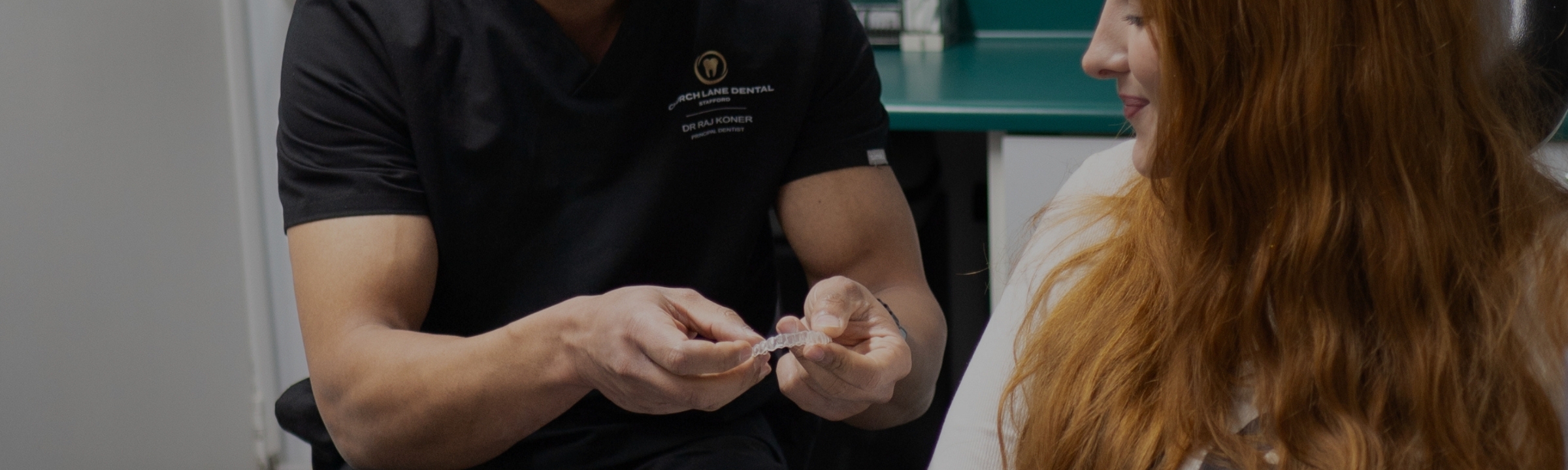
Invisalign uses a sequence of custom-made, removable clear aligners. Each aligner is worn for around 20 to 22 hours a day before you move on to the next one, as instructed by your clinician. They gradually guide your teeth towards their planned positions.
The aligners come out for eating, drinking anything other than water, and cleaning your teeth. This is a major benefit for many adults. There are no brackets to work around at dinner, and you can brush and floss normally before placing the aligners back in.
You may need small, tooth-coloured attachments bonded to selected teeth. These give the aligner something to grip, helping it deliver more precise movements. Some plans also include small amounts of enamel contouring between teeth to create space safely. These details are common, carefully planned and explained before treatment begins.
Invisalign can be an excellent choice if appearance during treatment matters to you, you have a busy professional or social schedule, and you are confident you can stick to the wear time. It can also suit patients who want fewer food restrictions and a simpler cleaning routine.
The removable design is also useful for playing contact sports, as aligners can be taken out and a suitable mouthguard worn. However, removable only works in your favour if the aligners spend enough time in your mouth. Leaving them in a case for most of the day will slow progress and can compromise the result.
Fixed braces use brackets bonded to your teeth, connected by a wire. Your clinician adjusts the system at planned intervals to create steady, controlled movement. Because the braces stay in place, they are working around the clock without relying on you to remember to put them back in.
Modern braces are more refined than many people expect. Metal brackets remain a highly effective option, while ceramic braces are less noticeable against natural teeth. Your suitability for each option will depend on the clinical requirements of your treatment.
Fixed braces are often recommended where tooth movements are especially complex, where bite correction needs close control, or where an aligner may be difficult to wear consistently. They can be particularly practical for teenagers, although plenty of adults choose them too because they value their predictability.
They also remove one daily decision. You do not need to remember an aligner before leaving home, after a meal or before bed. For some patients, that certainty is more reassuring than the discreet appearance of a removable option.
The most visible difference is appearance. Invisalign aligners are clear and subtle from a normal conversational distance, although attachments can sometimes be seen close up. Fixed braces are more noticeable, even when ceramic brackets are used. If you are regularly client-facing, presenting at work or simply want treatment to stay as discreet as possible, this may carry real weight.
Comfort is more personal. Both treatments create pressure when teeth are moving, particularly after a new aligner or adjustment. Invisalign has smooth edges and no wires, so there is usually less risk of irritation to the cheeks and lips. Fixed braces can rub at first or after an adjustment, but orthodontic wax can help and the mouth usually adapts quickly.
Cleaning is simpler with Invisalign because you remove the aligners to brush and floss. With fixed braces, you will need to clean carefully around brackets and under wires. Interdental brushes and extra attention around the gumline are essential. This is not difficult once it becomes a habit, but it does require consistency.
Food is another clear divider. With braces, hard, sticky and very chewy foods can damage brackets or wires, so you will be asked to avoid particular items. With Invisalign, you can eat as normal once the aligners are out. The trade-off is that you need to brush before reinserting them, especially after sugary drinks or snacks, to avoid trapping sugars against the teeth.
Appointments differ too. Fixed braces need regular adjustment visits, while Invisalign reviews are arranged to monitor progress and issue further aligners where appropriate. Neither is a treatment to manage alone. Regular professional oversight helps keep movement on track and identifies issues early.
Treatment duration varies widely. A limited cosmetic correction can sometimes be completed in months, while more comprehensive orthodontic treatment may take considerably longer. The complexity of your bite, the movements required, your oral health and, with Invisalign, your wear time all influence the timeline.
Neither treatment can promise a permanent result without retention. Teeth have a natural tendency to shift throughout life, even after excellent orthodontic care. Once active treatment is complete, retainers protect the investment you have made in your smile. You may be advised to wear them full-time initially and then overnight long term.
This stage matters just as much whether you have chosen aligners or braces. A beautifully finished smile needs a practical retainer plan and the commitment to follow it.
It is understandable to compare prices, but the cheapest quote does not always represent the best value. Orthodontic fees can include diagnostic records, digital scans, clinical planning, attachments or brace adjustments, review appointments, refinements and retainers. Ask what is included, what could be charged separately and whether finance options are available.
The more complex your treatment, the more important experienced planning becomes. A clear aligner is not automatically a simpler clinical case, and a fixed brace is not automatically the more expensive route. The right treatment is the one designed to achieve a stable, healthy result without cutting corners.
Before starting either option, your teeth and gums should be healthy. Active decay, gum disease, broken teeth or untreated pain need attention first. This protects your oral health and gives orthodontic treatment the best possible foundation.
At Church Lane Dental, a free orthodontic consultation can help turn uncertainty into a clear plan. You can discuss the look you want, any concerns about work or family life, your expected treatment commitment and the practical costs involved. If you are nervous about dental treatment, say so from the beginning – a calm, tailored approach makes a real difference.
The best appliance is the one that can deliver the movement your smile needs and that you can realistically live with every day. Choose with the end result in mind: teeth that look confident, meet comfortably and are easier to care for long after treatment has finished.
Back to blog
Quickly match your needs with the right dental treatment using our simple treatment finder.
Have questions or ready to book? Reach out, and our team will guide you every step of the way.


Follow us on Instagram for real patient transformations, behind the scenes updates and the latest offers. It’s the easiest way to stay connected and inspired on your smile journey.
EXPLORE