Staffordshire's highest rated dental practice - we guarantee the best quality dental care at great prices! Full range of dental care available - we can do everything under one roof!



A missing tooth can affect far more than a photograph. You may avoid certain foods, cover your mouth when you laugh or feel self-conscious speaking at work. Dental implant treatment that Stafford patients choose is designed to replace the tooth from the root upwards, giving you a secure, natural-looking result that feels much closer to having your own tooth again.
Implants are not a one-size-fits-all answer, and a good treatment plan should never pretend otherwise. The right solution depends on your oral health, the condition of your jawbone, the number of teeth being replaced and what matters most to you – whether that is confidence, comfort, speed, budget or all four.
A dental implant is a small titanium post placed carefully into the jawbone where a tooth root once sat. Over time, the bone bonds with the implant in a process called osseointegration. Once it is stable, a custom-made crown is attached to create the visible part of the tooth.
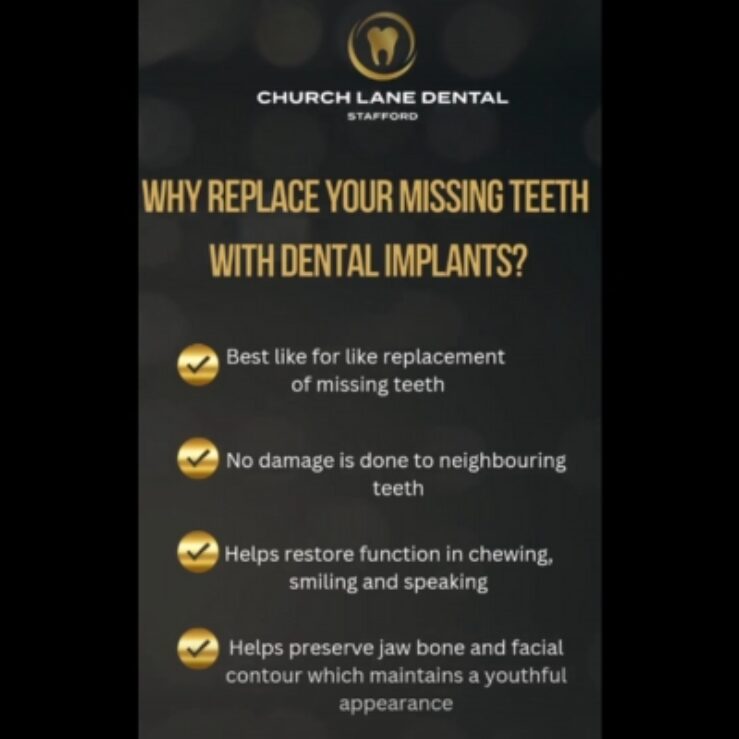
For a single missing tooth, this means neighbouring healthy teeth do not usually need to be cut down, as they would for a conventional bridge. Implants can also support several replacement teeth or help secure a full arch of teeth when a denture feels loose or moves while eating and talking.
The aim is not simply to fill a gap. It is to restore bite function, facial support and the confidence to eat, speak and smile without worrying about a removable appliance shifting at the wrong moment.
Many adults are suitable for implants, including people who have lived with a missing tooth for years. The key question is whether there is enough healthy bone to support the implant and whether your gums are stable. A detailed clinical assessment, usually supported by digital imaging or a 3D scan, gives your dentist the information needed to plan safely and precisely.
You may be a strong candidate if you have one or more missing teeth, a bridge that keeps failing, or dentures that no longer feel secure. Implants can be especially appealing if you want a fixed option that does not need to be removed at night.
Some situations need more preparation. Active gum disease must be treated before implant placement, and bone loss may mean a graft is needed to build a stronger foundation. Smoking can slow healing and increase the risk of complications, while uncontrolled health conditions such as diabetes need careful management. These factors do not automatically rule treatment out, but they can affect the timing, treatment plan and long-term outlook.
If you are nervous about dental treatment, say so from the beginning. Feeling anxious should not stop you from replacing a tooth. A calm consultation, clear explanations and suitable sedation options can make a significant difference to how manageable the process feels.
Treatment begins with a consultation rather than a quick decision. Your dentist will examine your teeth and gums, assess your bite, discuss your medical history and talk through the appearance you would like to achieve. Planning is particularly important in the smile zone, where the shape, shade and gum line of the final crown all need to look right alongside your natural teeth.
Scans allow the implant position to be planned around the available bone and important structures in the jaw. If a failing tooth needs to be removed, your dentist will assess whether the implant can be placed at the same appointment or whether the area should heal first. Both approaches can be appropriate. Immediate placement may shorten the overall timeline in selected cases, but waiting is sometimes the more predictable option when infection, bone quality or gum health is a concern.
The implant is placed under local anaesthetic, so you should not feel pain during the procedure. Most patients describe pressure and vibration rather than discomfort. The appointment length varies according to the complexity of the case, but replacing one tooth is very different from rebuilding a full arch.
After placement, the implant needs time to bond with the jawbone. This healing phase often takes several months. In some cases, a temporary tooth can be fitted so you are not left with a visible gap while the site heals. Your dentist will advise whether this is suitable and how much pressure the temporary restoration can safely take.
When the implant is ready, a connector called an abutment and the final crown are fitted. The crown is individually designed to complement your surrounding teeth, not look like a generic replacement. Small adjustments to the bite are made to ensure it feels comfortable when you chew.
For several missing teeth, the final restoration may be a bridge supported by implants. For full-mouth treatment, a fixed bridge or implant-retained denture may be recommended. The best route depends on bone volume, facial support, hygiene needs and how fixed you want the final teeth to feel.
Most people return to normal daily activities quickly after implant surgery, although it is sensible to keep the rest of the day quiet. Mild swelling, tenderness and bruising can occur for a few days. Your dentist will give tailored aftercare advice, which may include taking pain relief as directed, eating softer foods initially and avoiding smoking and alcohol while the area heals.
Good healing is about protecting the site without neglecting the rest of your mouth. Keep the area clean as instructed, attend review appointments and avoid testing the implant by biting hard foods too early. If you experience increasing pain, persistent bleeding, swelling that worsens or anything that does not feel right, contact your dental team promptly.
An implant is designed to be a long-term solution, but it still relies on healthy gums. The crown cannot decay, yet plaque can cause inflammation around the implant. Brushing carefully, cleaning between teeth and attending routine hygiene visits are essential to protect your investment.
There is no universal winner. A bridge can be a good option when the neighbouring teeth already need crowns, and it may be completed more quickly than an implant. A removable denture is generally the least invasive and can be a practical choice when several teeth are missing or budget is the deciding factor.
Implants offer distinct advantages: they are fixed in place, preserve neighbouring teeth and can help limit further bone loss in the jaw. However, they involve surgery, a longer treatment journey and a higher initial cost. The most valuable conversation is not about choosing the most expensive option. It is about choosing the option that is clinically appropriate and will work for your lifestyle over the years ahead.
The cost of implant treatment varies because no two mouths are the same. A straightforward single implant is different from treatment that includes an extraction, bone graft, temporary tooth, multiple implants or a full-arch restoration. Your written plan should make clear what is included, what may be needed later and how payments can be managed.
At Church Lane Dental, patients can discuss a tailored plan, transparent fee guidance and finance options before committing to treatment. That clarity matters. You should have time to ask about the expected timeline, likely maintenance, alternatives and the result you can realistically expect.
A missing tooth does not have to become the part of your smile you plan around. Start with a proper assessment, ask the questions that matter to you and choose a treatment plan that gives you confidence not only on the day your new tooth is fitted, but every day after it.
Back to blog
Quickly match your needs with the right dental treatment using our simple treatment finder.
Have questions or ready to book? Reach out, and our team will guide you every step of the way.


Follow us on Instagram for real patient transformations, behind the scenes updates and the latest offers. It’s the easiest way to stay connected and inspired on your smile journey.
EXPLORE