Staffordshire's highest rated dental practice - we guarantee the best quality dental care at great prices! Full range of dental care available - we can do everything under one roof!



A missing tooth can change more than the way your smile looks. It can make chewing awkward, affect speech, allow neighbouring teeth to drift and leave you less willing to smile in photographs or meetings. The best options for missing teeth depend on where the gap is, how many teeth are missing, the condition of your gums and jawbone, and what matters most to you: a fixed result, a quicker solution or a more budget-conscious plan.
There is no one-size-fits-all answer. A well-planned replacement should feel comfortable, protect your remaining teeth and suit your life, not simply fill a space. A consultation is the point where those choices become clear, with an examination, X-rays or a 3D scan where appropriate, and a treatment plan built around your smile.
For a single missing tooth, a dental implant or bridge is often considered. For several missing teeth, an implant-supported bridge, a conventional bridge or a partial denture may be suitable. When all teeth in an arch are missing, removable dentures and fixed full-arch implant solutions can both offer life-changing results, but they work very differently.
The right choice is not always the most expensive treatment. It is the treatment that gives you reliable function, a natural-looking result and a level of maintenance you can comfortably commit to.
A dental implant replaces the root of a missing tooth with a small titanium post placed in the jawbone. Once it has healed and integrated with the bone, it supports a custom-made crown, bridge or denture. Because the implant sits beneath the gumline, it provides a stable foundation rather than resting on surrounding teeth or gums.
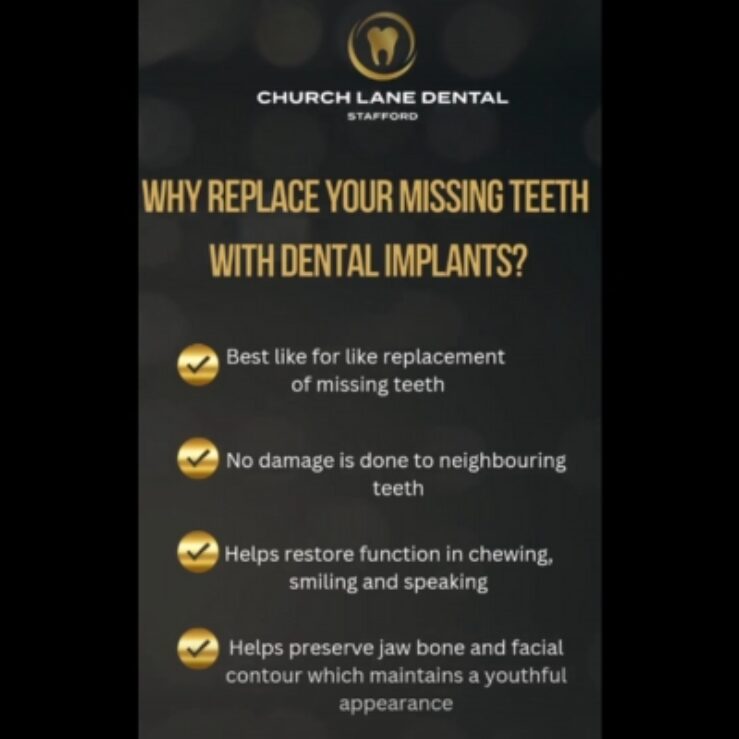
For many patients, an implant is the preferred option for a single gap. It looks and functions much like a natural tooth, does not require the teeth either side to be filed down and can help preserve the bone in the area. You can usually eat, speak and smile with confidence once treatment is complete.
Implants can also replace multiple missing teeth. Two or more implants may support a bridge, while a carefully planned number of implants can stabilise a full arch of replacement teeth. This avoids the movement and pressure points that some people experience with removable dentures.
The trade-off is time and cost. Implant treatment requires healthy gums, enough supporting bone and good home care. Healing can take several months, although temporary teeth may be possible during the process. If bone has reduced after a tooth has been missing for some time, grafting may be recommended before or alongside implant placement.
Implants are often ideal for people who want a fixed, long-term solution and are happy to invest in a staged treatment plan. They may be especially valuable where a missing tooth is visible when you smile, where a loose denture is affecting confidence, or where you want to avoid altering healthy neighbouring teeth.
Smoking, uncontrolled gum disease and certain medical conditions can affect suitability and healing. That does not automatically rule treatment out, but it makes a detailed assessment and honest conversation essential.
A dental bridge closes a gap by attaching a replacement tooth to the teeth next to it. A traditional bridge uses crowns on the supporting teeth, while an adhesive bridge, sometimes called a Maryland bridge, is bonded discreetly to the back of an adjacent tooth.
A bridge can be an excellent choice when the teeth beside the gap already have large fillings, crowns or a need for restoration. It provides a fixed result, is generally completed more quickly than an implant and can restore the appearance of a front tooth very effectively.
An adhesive bridge is often a conservative solution for a single front tooth, particularly for younger adults who are not yet ready for implant treatment. It involves little or no drilling of the supporting tooth. However, it may not withstand the same biting forces as an implant or conventional bridge, especially at the back of the mouth, and can occasionally need rebonding.
A conventional bridge is strong and established, but it does mean reshaping the neighbouring teeth to support crowns. That is a sensible compromise in some cases, but less appealing where those teeth are completely healthy. Good cleaning around and beneath the bridge is vital to protect the supporting teeth and gums.
Modern dentures are not limited to the bulky, artificial-looking versions many people imagine. A well-designed partial denture can replace one or several teeth, while a full denture restores an entire upper or lower arch. The teeth are made to complement your face, smile and bite, with careful attention to shape, shade and comfort.
Dentures are often the most accessible way to replace multiple teeth. They do not require surgery, can usually be made relatively quickly and may be particularly useful when several teeth have been lost or when implants are not suitable at present. They can also serve as a temporary solution while gums heal after extractions or during implant planning.
Their limitation is that they are removable. They may take time to get used to, and lower dentures in particular can move during eating or speaking because there is less surface area for suction. Bone changes over time can also alter the fit, so adjustments or replacement may be needed.
For patients who like the affordability and appearance of dentures but want more stability, implant-retained dentures offer a middle ground. The denture remains removable for cleaning, but clips securely onto implants. This can make a major difference to confidence with food, conversation and day-to-day comfort.
When more than one tooth is missing, the focus should move beyond filling individual gaps. Your bite, facial support, speech and ability to eat comfortably all need to be considered.
An implant-supported bridge can replace several consecutive teeth without placing an implant for every single tooth. It is fixed in place and designed to feel secure. Where an entire arch needs replacing, a full-arch fixed implant bridge can provide a non-removable set of teeth, while implant-retained dentures provide increased stability with a removable design.
These treatments need careful planning. The health of your gums, the amount of available bone, your bite forces and whether you grind your teeth all influence the design. A clinician should also discuss the ongoing care involved. Fixed implant bridges need specialised cleaning around the implants, while removable solutions must be cleaned thoroughly every day and attended for regular reviews.
Start with the health of the foundation. Active gum disease, decay and infection should be treated before a final replacement is placed. If a tooth has only recently been lost, acting promptly can sometimes reduce bone loss and make future options more straightforward.
Then consider how you want the replacement to work. A fixed tooth is often the priority for someone who wants the closest feel to natural teeth. A removable solution may be the right first step for someone replacing many teeth, working to a tighter budget or needing treatment completed sooner.
Appearance matters too, particularly at the front of the mouth. The best result is not simply the whitest tooth. It is a replacement that matches your surrounding teeth, gumline, facial features and smile. Your dentist should show you what is realistic and explain where compromises may be needed.
Cost should be clear from the beginning. The initial fee is only part of the picture: consider likely maintenance, reviews, repairs and the expected lifespan of the treatment. Finance options can make a higher-value treatment more manageable, but the decision should still be based on suitability rather than monthly cost alone.
Not every missing tooth needs immediate replacement, particularly if it is at the very back of the mouth and your bite remains stable. But waiting without an assessment can allow adjacent teeth to tilt into the space, opposing teeth to over-erupt and the jawbone to shrink. These changes can make later treatment more complex.
If a tooth has just been knocked out, fractured beyond repair or lost because of severe pain or infection, urgent care comes first. A dentist can relieve discomfort, manage infection where needed and discuss temporary options before moving to a lasting restoration. Church Lane Dental offers urgent appointments alongside complete restorative planning, so you do not have to choose between immediate help and long-term care.
A missing tooth does not have to become the part of your smile you work around. Book an assessment, ask what each option would mean for your teeth and lifestyle, and choose a plan that gives you the confidence to eat, speak and smile freely again.
Back to blog
Quickly match your needs with the right dental treatment using our simple treatment finder.
Have questions or ready to book? Reach out, and our team will guide you every step of the way.


Follow us on Instagram for real patient transformations, behind the scenes updates and the latest offers. It’s the easiest way to stay connected and inspired on your smile journey.
EXPLORE